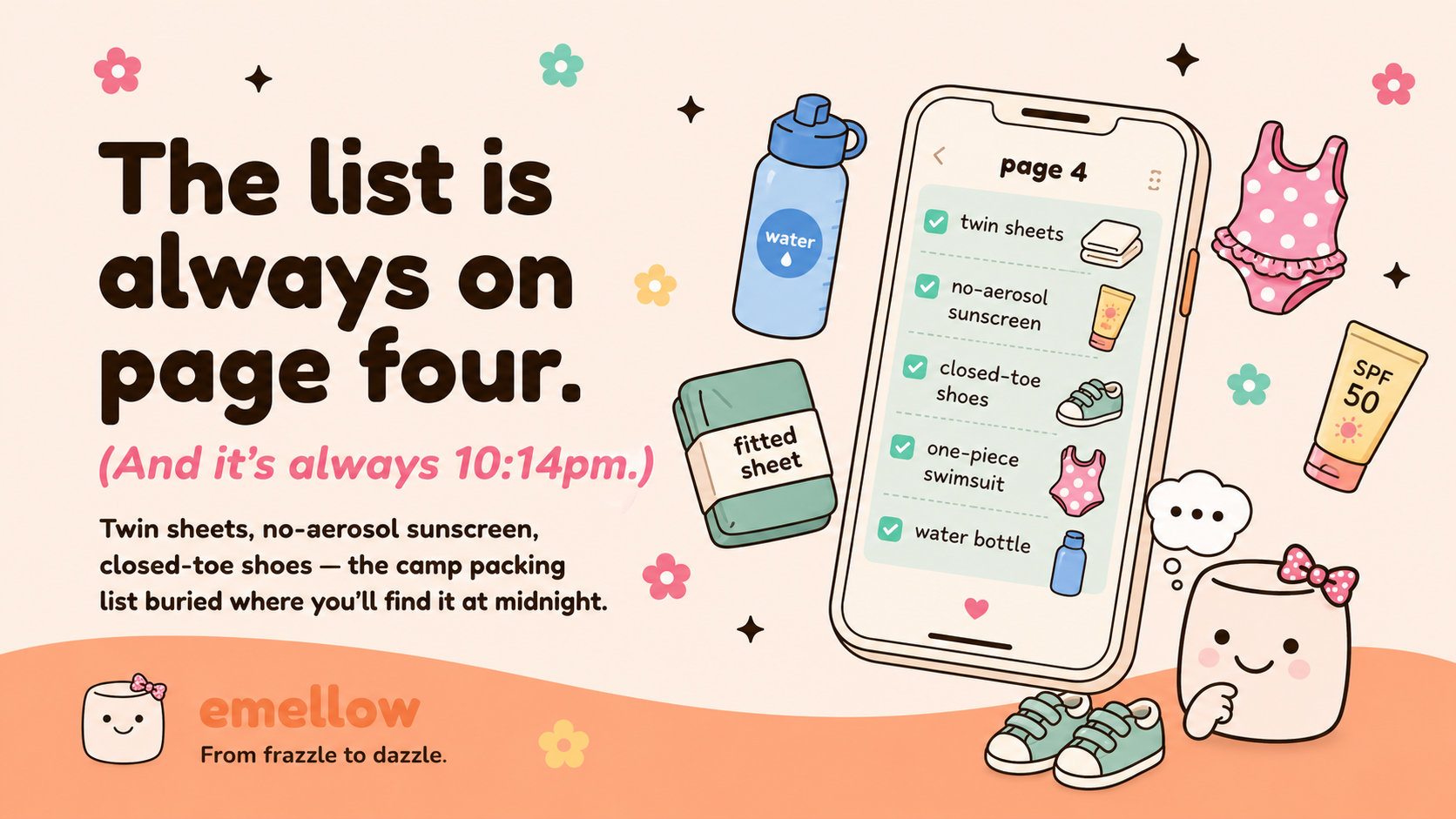
It's 10:14 p.m. on a Sunday. You're in bed with a phone, scrolling the camp confirmation email from February. The packing list was attached as a PDF. The PDF is six pages long. The first page is a welcome letter. The second is a map. The third is emergency contacts. The actual list of what to pack — labeled water bottle, twin-size fitted sheet, one-piece swimsuit, closed- toe shoes, no aerosol sunscreen — is on page four.
Drop-off is at 7:30 a.m. You have not packed.
This isn't a story about summer camp. This is a story about every week.
Orange slices and plates by Thursday. Two dollars cash for the kindness fundraiser Friday. White shirt, black pants, hair tied back for the spring concert Monday. A labeled backpack with exactly one snack, no nuts, for the field trip Tuesday. A costume for Book Character Day Wednesday and, be honest, you forgot until you saw the other kid at drop-off dressed as Fancy Nancy.
Every one of those is a what-to-bring. And every what-to-bring is the hidden half of a logistics task that looked small when it arrived.
Why the list is always on page four
Nobody decides to bury the what-to-bring. It happens because of how institutions write to parents.
The headline always goes first. "Field trip to the aquarium." "Camp check-in this Sunday." "Spring concert Thursday, 6 p.m." "Blue/white day Friday." These are the hooks — the thing the institution wants you to remember first, because it's the event itself.
Then comes context. Where to arrive. What time. What's happening. Reminders about permissions, photos, dismissal, parking.
The what-to-bring comes last, because it's the most operational part of the email. It's the part the teacher or coach or camp director knows will change between now and the event, so they save it for the bottom.
By the time you reach the what-to-bring, you've been reading for thirty seconds. Your brain has already filed the email under "done." You remember the event. You don't remember the list.
This is the anticipating part of the work. It doesn't feel like work. It feels like forgetting. It isn't.
The hidden cost of a four-word list
"Orange slices by Thursday."
Five words in a class email. Let's unpack them.
You read the email Monday. You remember orange slices. You don't remember which day — Thursday? Wednesday? — and you don't remember if it was a whole bag or a container or if paper plates got mentioned somewhere. Tuesday evening you think about it at 9 p.m. while brushing your teeth. Wednesday morning you mentally check the fridge and there are no oranges. Wednesday at 4:15 p.m. you swing by the grocery store with a tired kid. Wednesday night you slice oranges while your other kid asks you to help with a worksheet. Thursday morning you repack the slices into a rectangular labeled container because the round one didn't fit in the snack bin.
That's five separate cognitive checkpoints. One grocery stop. One slicing session. One container search. For five words in an email.
Multiply by four kids, three activities, fourteen weeks, and you have a rough picture of what the invisible labor of family logistics actually looks like.
What-to-brings that repeat year-round
This isn't a school-year problem. The what-to-bring follows your family across seasons, and the list sources multiply as kids get older:
- Summer camp: labeled water bottle, twin sheets, sunscreen (lotion only), closed-toe shoes, lanyard, flashlight, one modest swimsuit, a specific brand of insect repellent, a stamped addressed envelope.
- VBS: t-shirt by Monday, offering envelope by Wednesday, a friend by Thursday, a parent volunteer slot by Friday.
- Travel team: cleats, shin guards, mouthguard, two water bottles, a snack for the bench, and the tournament fee in cash.
- Swim lessons: goggles, swim cap (some pools require, some don't), one-piece for the under-six group, towel labeled, no jewelry, no lotion.
- Birthday orbit: gift, card, wrap, tape, and (surprisingly often) a pair of socks for the trampoline-park safety rule.
- Spring concert: white shirt, black pants, hair tied back, arrive thirty minutes early.
- Field day: water bottle, hat, change of clothes, closed-toe shoes, team-color shirt.
- Holiday party week: paper-plate craft supply, teacher gift card, a can of something for the food drive, a dozen store-bought cookies (not homemade — allergy-kitchen reasons).
Every single one is on page three, four, or five of the email it arrived in.
Three rules for catching the list
You can't control where the what-to-bring lives in an email. You can control what happens after you read it.
Rule one: extract the list the moment the email lands
When you open the camp confirmation, don't just skim the date. Scroll to the packing list. Copy it. Paste it into a single "what-to-brings" note on your phone, with the event name and date at the top. Thirty seconds. You will never reread the six-page PDF again.
The rule: the what-to-bring lives in your system, not in the email. The email is the source. Your note is the operational document.
Rule two: pre-shop the week
Sunday evening, open the note. Read every what-to-bring due by Friday. Check what's in the pantry. Make one grocery list for the week. Buy everything at once.
This is the difference between five stop-at-the-store-on-the-way-home trips and one deliberate shop. Parent math, in its purest form.
Rule three: pack the night before, in sight of the list
Packing a backpack from memory at 7:02 a.m. while the kid is eating cereal and asking about dinosaurs is not a system. Packing a backpack at 9 p.m. the night before, with the what-to-bring note open on your phone, is a system.
The note gets read. The backpack gets packed. The morning has three fewer decisions in it.
The Thursday-at-4:58 p.m. email
The other reason the list feels hidden: it often arrives at the worst possible moment. Teachers email at the end of the day, which is the start of your dinner. Coaches post to the team app during their lunch break, which is during your Zoom. Camp directors update the portal Saturday morning, which is the moment you're standing at a soccer field watching a different kid.
The what-to-bring arrives while you are physically somewhere else. You catch half of it. You forget the rest. You remember at 10:14 p.m. on a Sunday, in bed, scrolling.
This is the part that doesn't go away with a better folder system. The emails will keep arriving at the wrong time. The group texts will keep dropping the list mid-thread. The portal will keep updating at 11 p.m. You can't make the information arrive on your schedule.
You can put something between the information and your head.
Where mellie fits
mellie reads every email, every signup confirmation, every group text, every portal notification — and pulls the what-to-bring out of page four automatically. Orange slices by Thursday becomes a reminder Monday, a grocery-list item Tuesday, a pack-the-container nudge Wednesday night. The six-page camp PDF becomes a clean packing list in your phone the moment the confirmation lands.
No more panic-scrolling at 10:14 p.m. No more Sunday-night inbox open-and-close. No more remembering the list on the way to drop-off and turning the car around.
Show up on time, everything in hand, all forms signed. Orange slices labeled. Water bottle packed. Mouthguard in the side pocket.
Built by parents, for parents. From frazzle to dazzle.