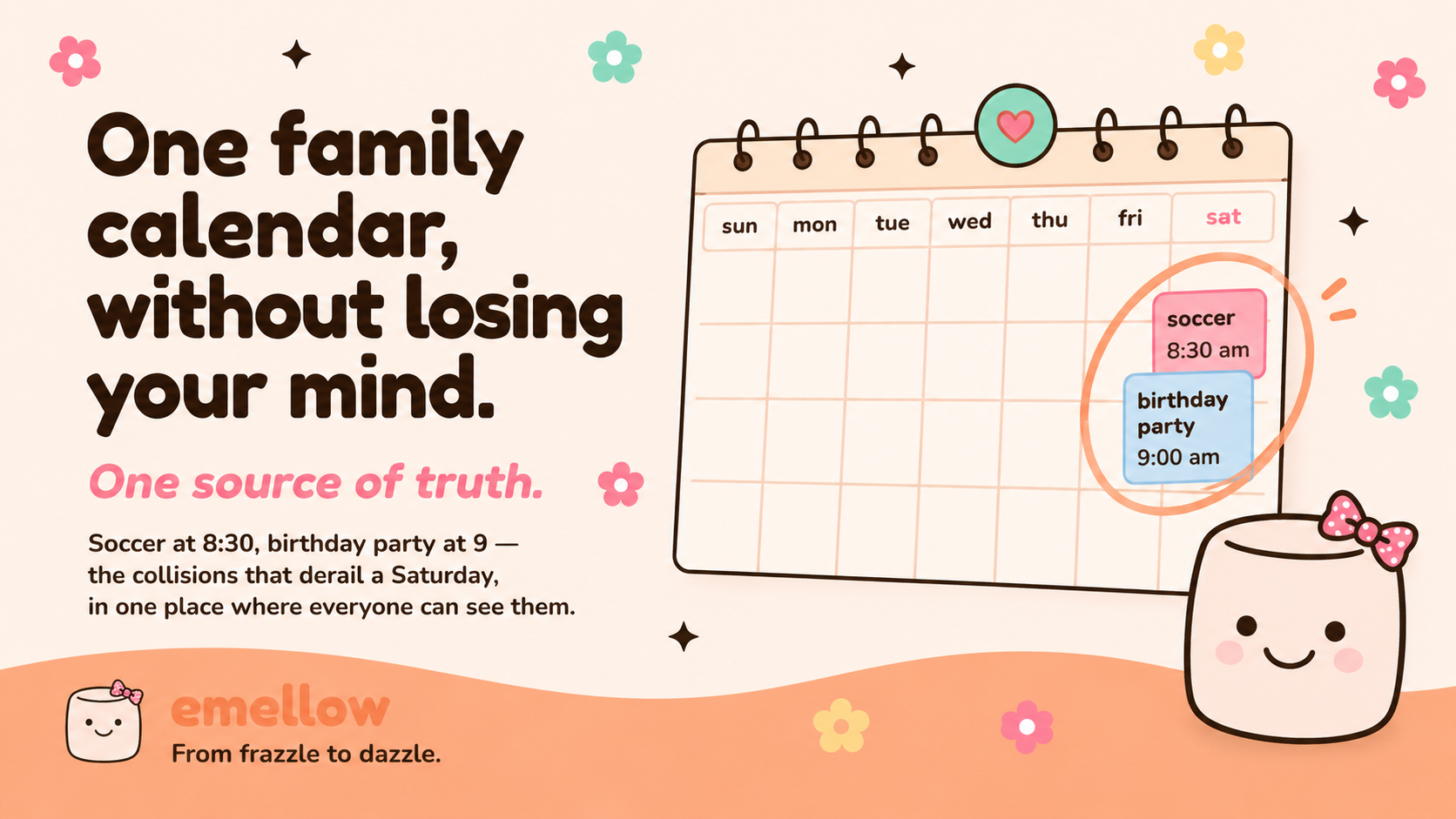
It's 7:48 a.m. on a Saturday. You're halfway out the door with soccer bag number one when your phone buzzes. Your kid's travel-team coach just moved the 9 a.m. game to 8:30. Your other kid has a birthday party at 10:00 a.m. across town. Your partner thinks the birthday party is at noon, because that's what's on the shared calendar. The Evite said 10 a.m. You RSVP'd yes four weeks ago on your phone, while standing in line at Target, and never added it to the calendar because you were going to do it when you got home, which you did not.
The double-booked Saturday has arrived.
The shared family calendar is supposed to prevent this. In theory, it's one source of truth. Two parents, three kids, forty commitments, one grid. Everyone sees the same thing. Nobody double-books.
In practice, it breaks. Not because anyone is careless. Because calendars were built to store what's already decided — and the family year is mostly the stuff that's still forming.
What a calendar is actually good at
Give a calendar a date, a time, and a title and it will hold them forever. 9 a.m. Saturday, soccer game, Field 3. It will remind you. It will show both parents the same block. It will sync to a watch, a phone, a laptop. On the execution side, calendars are great.
The parts they're great at:
- Recurring events with stable times (piano Tuesday at 4).
- Events with a firm date-and-time the moment they land on your radar (doctor, dentist, first-day-of-camp drop-off).
- Travel, flights, big-ticket plans that arrive fully formed.
The parts they can't do — which is most of the family year:
- Anything that arrives as a PDF, an Evite, a group-text scroll, a backpack paper, or a 4:58 p.m. teacher email.
- Anything with a what-to-bring attached.
- Anything that requires a permission slip, a registration, a payment, or a follow-up before the date on the calendar means anything.
- Anything still in the "we should probably RSVP" state.
A calendar is an execution tool. What parents need is an anticipating and monitoring tool plus a calendar. Most families only have the calendar. That's the gap.
Three failure modes nobody admits to
The shared calendar breaks in the same three ways in almost every house. Naming them is the first step to fixing them.
Failure one: the lag between inbox and calendar
An event arrives via email, text, Evite, or the school portal. It lives there — in the inbox — until someone moves it to the calendar. The move is manual. The move requires opening the email, reading the details, deciding if you're going, finding the calendar, creating the event, adding the location, adding the notes, and inviting the other parent.
It's a four-minute task. It almost never happens in the moment the email arrives.
So the event sits in the inbox for a day, a week, or until someone double-books. The calendar looks clean. The calendar is lying.
Fix: a fifteen-minute inbox-to-calendar ritual twice a week. Sunday night, Wednesday night. Every new event gets moved. Everything RSVP'd gets logged. Everything declined gets deleted. Set a timer. Don't overthink.
Failure two: one parent enters, the other parent doesn't see it
You add the birthday party to the calendar. You add the travel-team tournament to the calendar. You add the kindergarten teacher conference to the calendar.
Your partner is on a different calendar app. Your partner is on the same calendar app but logged into a personal account. Your partner has the family calendar hidden because last month they turned it off to reduce notifications during a work sprint and never turned it back on.
This is the default parent problem dressed up as a tech problem. One person enters, one person monitors, and the calendar becomes a reflection of one head rather than two.
Fix: the calendar is not a sync tool until both parents confirm they can see it on their primary phone home screen, this week, right now. That's the bar. If either person has to "go check," the calendar has failed at its one job.
Failure three: calendars don't hold the what-to-bring
The calendar says Spring Concert Thursday, 6 p.m., Chapel. It does not say white shirt, black pants, hair tied back, arrive at 5:30, enter through the side door. That information is in the teacher's email from last Tuesday. Your calendar is complete. Your morning is not.
This is the what-to-bring gap. The calendar holds when. It doesn't hold what. The two are a single logistical event, but the calendar only stores one side of it.
Fix: when you move an event from inbox to calendar, drop the what-to-bring into the notes field verbatim. Don't summarize. Copy-paste. Future-you needs it at 7 a.m., not at 10 p.m. the night before.
The birthday-orbit problem
Birthday parties are the cleanest example of everything breaking at once. The Evite arrives. Four weeks out. The party is on a Saturday. You RSVP on your phone while walking into Target. You don't add it to the calendar. Your partner doesn't see the RSVP. The following week, another Evite arrives — same Saturday. Your partner RSVPs that one. Nobody adds either to the calendar.
Two weeks out, the first host texts to confirm numbers. You confirm, still without adding it to the calendar.
One week out, the second host texts the address and a what-to-bring (gift wrapped, swimsuit under clothes, towel labeled). The text is in your partner's phone, not yours.
Saturday morning: two parties, overlapping windows, one car, one forgotten swimsuit, a gift wrapped in the wrong paper for the wrong kid.
The fix is not "use the calendar better." The fix is that Evites, group texts, and party confirmations need to land somewhere other than one parent's inbox.
What actually holds
Three things. Small, boring, load-bearing.
A twice-weekly inbox sweep. Sunday night, Wednesday night. Fifteen minutes. Move events. Add notes. Decline what you're declining. Nothing waits more than three days between inbox and calendar.
One calendar, both phones, home screen, today. Not next week. Not "we keep meaning to." Home screen. Today.
The notes field is not optional. Every event gets a what-to-bring and an arrive-by-time. If there isn't one, write "none" so future-you knows.
These are habits, not tools. They will hold for a month and then break when someone gets sick or someone's job gets busy. That's not a failure of the habit. That's the shape of real life.
The part the calendar will never do
Even when the habits are holding, the calendar will not do the anticipating. It won't notice that the travel team's coach moved the game. It won't surface the what-to-bring from last Tuesday's teacher email at 9 p.m. Thursday night. It won't flag that the Evite you RSVP'd to is on the same Saturday as the tournament you already have two kids signed up for.
Those are not calendar jobs. Those are worry work jobs — the low-grade monitoring your head is doing in the background while you're trying to watch a movie. The calendar stores the decisions. The worry work keeps the decisions from collapsing into each other.
For most families, the worry work lives in one person's head.
Where mellie fits
mellie reads every school email, every Evite, every coach text, every camp confirmation, every calendar invite. Before the double-booked Saturday happens, mellie flags it — the travel-team game and the birthday party are the same morning, the soccer game just moved earlier, the Evite from four weeks ago RSVP'd yes and needs a gift.
mellie doesn't replace the calendar. mellie feeds it. The things you already decided stay in your calendar, where they belong. The things that are still forming — the RSVPs, the what-to-brings, the "is-this-Saturday-or-next" — live in mellie until they're ready to move.
No more double-booked Saturdays. No more panic-scrolling through the inbox looking for the gift-wrapping instruction. No more one parent holding the whole family year in their head.
Show up on time, everything in hand, all forms signed. One calendar. Two parents. Three kids. A Saturday that goes the way you planned it.
Built by parents, for parents. From frazzle to dazzle.