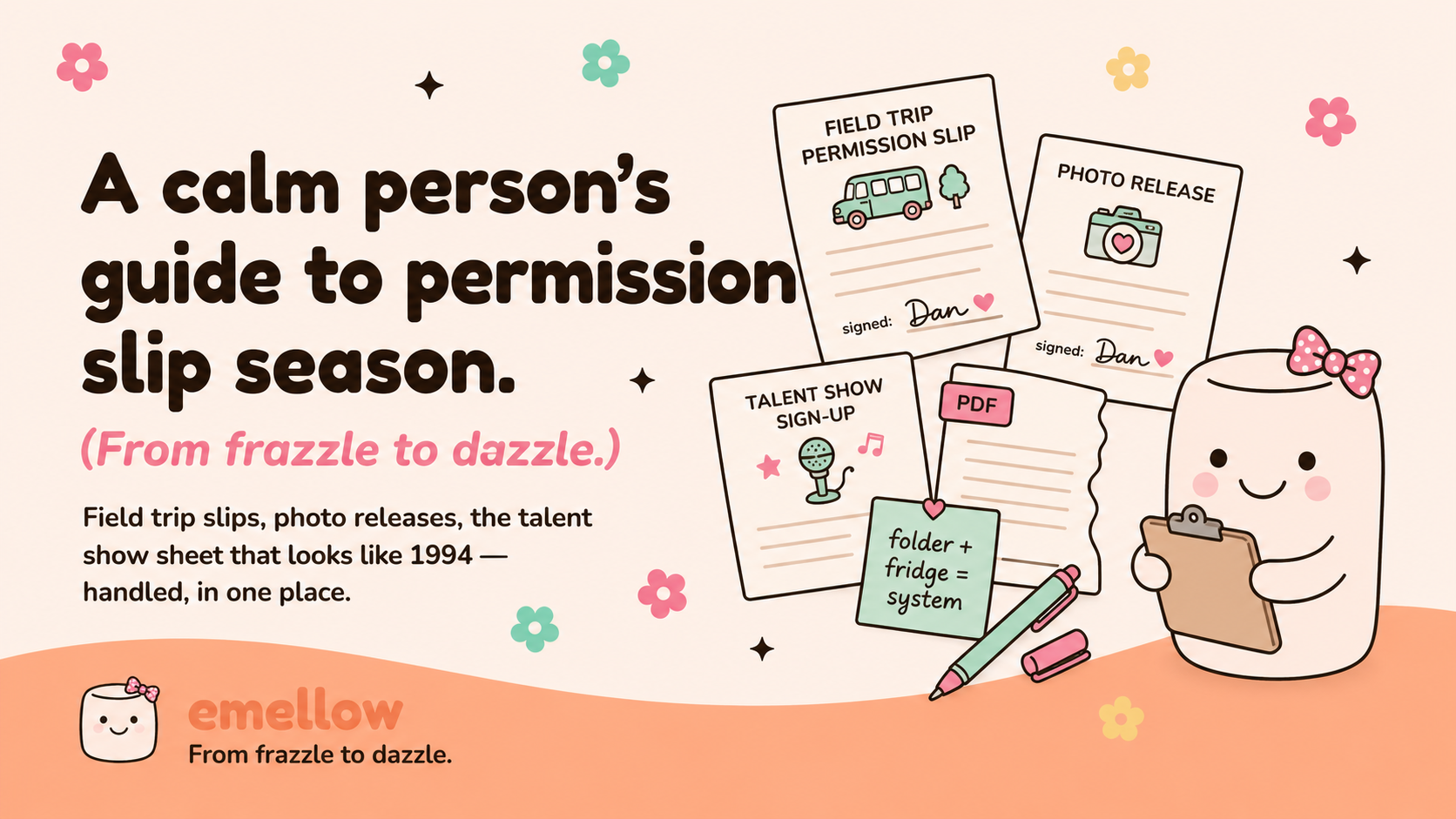
The counter has four papers on it. One is a permission slip for the aquarium field trip, due yesterday. One is a photo release you've signed three times before but apparently not this year. One is a sign-up for the fourth-grade share-a-talent showcase that you didn't know was happening until your kid handed you the sheet at 8:14 p.m. on a Sunday. One is a PDF someone printed at school that you're pretty sure is a duplicate of the field-trip slip but you can't tell because the top half is missing.
Your kid is standing in the kitchen asking if you signed it yet.
You haven't.
This happens four times a year. Fall. Mid-winter. Spring concert orbit. End of year. It's not a school-year thing — travel-team tryouts bring their own waiver stack, summer camps drop a consent-form PDF the week of check-in, swim lessons want a medical form by Friday. The shape is the same: a sudden two-week window where every institution your kid touches needs a signature.
The counter pile isn't a personality problem. It's an operational problem pretending to be a character flaw. Here's the playbook.
What a permission slip actually costs
A permission slip looks like a ninety-second task. Sign, date, send back.
It isn't.
The real work happens before you ever pick up the pen. You had to notice the slip existed — which means opening the backpack, reading the teacher's Thursday-at-4:58-p.m. email, or catching the reminder in the parent portal before it scrolled past. You had to track what it was for, when it was due, and whether a second form (medical, photo, lunch choice) hitched a ride. You had to hold all of that in your head long enough to actually sign it at the moment the kid remembered to hand it over, which is rarely the moment the form appears.
That's anticipating and monitoring work — two of the most invisible parts of the family year. Researchers name these as the phases that fall disproportionately on one person in most households, usually the default parent. They're the parts that don't leave a trail.
So the ninety-second task is actually a two-week surveillance project. No wonder the pile reads as a judgment.
The two-week sprint, mapped
Permission slip season isn't one event. It's a wave with predictable shape. Name the shape and you stop reacting to each paper like it's a surprise.
Week one — the intake
The forms arrive faster than you can read them. Field-trip slips. Photo releases. Media-consent updates. The PTA fundraiser sheet. The spring concert attendance form. A sign-up for the end-of-year kindness project. The fourth-grader's talent-show card that looks like it came from a photocopier in 1994.
The goal in week one is not to complete anything. The goal is to capture.
- One spot for every paper. A clipboard on the counter, a folder on the dining-room shelf, a tray by the door — pick one, put everything in it.
- One spot for every email. Create a label called "school forms" and drop anything signature-shaped into it as it arrives.
- One quick glance per paper. Read the due date. Write it on the top corner in pen. Put the paper back in the pile.
That's it. You are a librarian this week, not an executor. Capture over completion.
Week two — the sweep
Week two is where the signing happens. Pick a window — twenty minutes on a Tuesday night, or the first coffee on Saturday — and do every form that's due in the next seven days. Don't do them one at a time as they come in. Batch them.
Batching works for three reasons. The pen is already in your hand. You've already located the medical-info sheet in your phone notes, so the second form takes a fraction of the first. And you'll catch duplicates, misprints, and the slip that got signed twice — because you're seeing them side by side.
Sign. Date. Initial. Back into the folder, back into the backpack, note on the calendar so the kid doesn't forget to hand it in.
The day-of check
The morning the form is due is the most dangerous moment. The form is signed but still on the counter. The backpack is zipped. The kid is eating cereal. The form does not walk itself to school.
Build one thirty-second ritual: the day before the due date, forms move from folder to backpack. Not the morning of. The night before. This is the difference between a system that holds and a system that falls apart at the last mile.
The "what to bring" trap
Half of what looks like a permission slip is actually a permission slip plus a what-to-bring list. The slip is one line. The what-to-bring is buried on page two, or in the teacher's email body, or in the parent-portal announcement you saw Tuesday and can't find Friday.
Examples, year-round:
- Field trip: signed slip plus sack lunch in a plastic bag plus no glass containers plus two dollars for the gift-shop optional.
- Camp check-in: signed medical form plus labeled water bottle plus sunscreen (spray not allowed) plus closed-toe shoes.
- Spring concert: signed attendance form plus white shirt, black pants, hair tied back.
- Team tryout: signed waiver plus mouthguard plus shin guards plus water bottle with name on it.
The signature is the easy half. The what-to-bring is where things actually go wrong, because it requires a second sweep of the teacher's email and a shopping trip and a packing moment at 9:45 p.m. the night before.
When you're capturing forms in week one, capture the what-to-bring at the same time. Same folder. Same system. The form and the list are one piece of logistics, not two.
Three failure modes nobody admits to
The counter pile is predictable. So are the ways it goes sideways.
Failure one: one person holds it all
The permission slip lives in one parent's head because that parent opened the backpack, read the email, and remembered when it was due. The other parent doesn't know it exists. This isn't about fairness — it's about redundancy. If the whole operation runs through one person, every sick day, every late meeting, every forgotten phone sinks the whole two weeks.
Fix: the capture folder is shared. The "school forms" email label is shared. Both parents see the pile. Both parents see the due dates.
Failure two: the signature without the system
You signed the slip on Monday. It's Friday. The slip is in the pocket of the jeans you haven't worn since Monday. The kid's teacher emailed asking about it. Your kid got in trouble for not having it.
Fix: the signature isn't the finish line. The handoff is. Forms move to the backpack the night before, period.
Failure three: the quiet duplicate
Some forms get sent twice — once via backpack, once via email. You sign both. The school thinks you signed two different slips. The kid hears a small version of this and thinks you did something wrong. You didn't.
Fix: one folder, one email label. When you batch-sign on Saturday, you see the duplicate before the school does.
What this looks like when it works
The counter is clear by 9 p.m. The field-trip slip is in the backpack. The photo release is in the teacher's inbox. The talent-show sign-up is on the calendar for next Thursday. The medical form for camp is saved as a PDF in a folder called "summer forms," which you haven't had to open since March and don't have to open again until June.
Your kid asks if you signed the slip. You already did. You did it Saturday while you were drinking coffee.
That's the goal. Show up on time, everything in hand, all forms signed.
Not because you're a machine. Because the system is doing the holding instead of your head.
Where mellie fits
You can run this playbook manually. Plenty of parents do. The capture folder, the email label, the Saturday batch window, the night-before handoff — none of that requires a tool.
What it does require is noticing every form exists in the first place. And that's the part that doesn't scale. There isn't one teacher emailing permission slips. There are four teachers, two coaches, a camp director, a pediatrician's office, the VBS registration portal, a travel-team admin, the birthday-party host who wants a waiver signed before the trampoline park. Every one of them uses a different inbox, a different form, a different due date.
mellie reads the pile. Every school email, every signup confirmation, every portal notification, every group text — pulled into one view, organized by kid, surfaced by due date. Permission slip arrives Thursday at 4:58 p.m., mellie tells you Friday morning that it exists and when it's due. The what-to-bring list gets pulled out of page four of the PDF and added to the Saturday shopping list.
No more panic-scrolling. No more Sunday-night inbox open-and-close. The mental load moves from your head to a system that holds it.
Built by parents, for parents. From frazzle to dazzle.