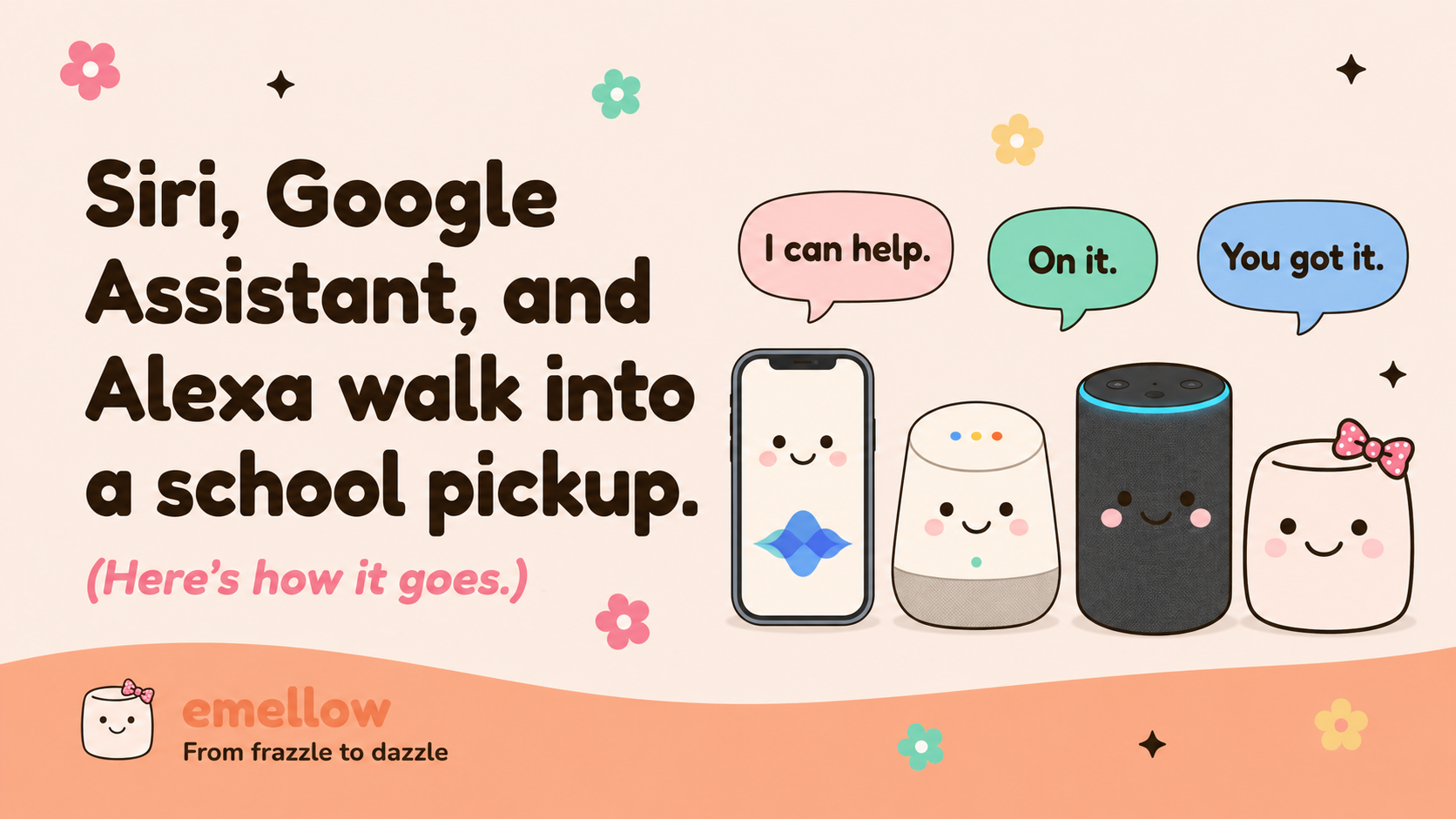
You're eighth in the pickup line. The bell rang four minutes ago. Your kid is going to climb in the back in forty-five seconds and ask whether the field trip is tomorrow or Thursday, and you can't remember because the email was Thursday of last week and last week was a blur.
Hey Siri, when is Millie's field trip.
Siri returns a web search.
You try Hey Google on the Android in the cupholder. Google Assistant offers to add a calendar event. You say never mind. At home that night, you ask Alexa the same question while unpacking the lunchbox. Alexa tells you the field trip is a word from old English meaning "a short journey for educational purposes." Your kid laughs. You do not.
None of the three assistants on your phones and counters knew the answer. Not because they're bad products. Because they were never built to.
what the three voice assistants actually do
Credit where it's due. Siri, Google Assistant, and Alexa are three of the most successful consumer AI products ever shipped. They're genuinely useful for a tight set of jobs:
- Timers, alarms, and reminders. "Set a timer for fifteen minutes." "Remind me to move the laundry at 9." This is where all three live and thrive.
- Unit conversions and quick facts. "How many tablespoons in a cup." "How tall is the Empire State Building." Nailed it.
- Smart-home control. Lights, thermostats, locks, the Roomba. Voice-as-remote-control is the genuine superpower.
- Music, podcasts, and media playback. "Play the Frozen soundtrack in the kitchen." Done.
- Calling, texting, and calendar events you already know about. "Call Dad." "Text Jess I'm five minutes out." "Add 'dentist' Tuesday at 3."
All three are excellent at the execution layer. You know what you want. You say it. It happens. That is a good product.
The problem for parents isn't the execution layer. The default parent in most households already knows how to set a timer. What they don't have is the anticipating and monitoring layer — the one that notices a thing exists, holds it across weeks, and brings it back at the right moment. None of the three voice assistants do that layer. Never promised to.
the field trip question
Let's stay with the car-line scene for a minute, because it's a clean test.
Hey Siri, when is Millie's field trip. For Siri to answer, the field trip would need to already be on the calendar. Which means someone — the default parent — already did the noticing (opened the email), the tracking (parsed out the detail), and the execution (added it to the shared calendar with the right date). Siri's best case is reading back what you already put in. That's not help. That's a receipt.
Google Assistant is a little smarter about Gmail integration. If the field-trip email landed in your Gmail and Google parsed it as an "event" with a clear date, Google can sometimes surface it in Assistant. Sometimes. When the email is clean. When the teacher's subject line isn't "FW: FW: Weekly Update — please read!!!" Most parent inboxes are not clean. Most teacher emails are not clean. The "sometimes" is the problem.
Alexa isn't in this fight. Alexa's email integration is thin. Alexa's job is the kitchen and the living room — timers, music, thermostat. Asking Alexa about the field trip is asking a toaster for directions.
the three jobs, measured plainly
This topic uses one rubric for every AI tool we compare: does it do the noticing, the remembering, and the surfacing? Here's where the three voice assistants land.
Noticing
Siri. Does not read your inbox. Does not watch the school portal. Does not monitor group texts. If you don't tell Siri something exists, Siri does not know it exists.
Google Assistant. Reads Gmail, with your permission, through Google's assistant integration. Will sometimes surface an event it parsed. Does not reliably read "what-to-bring" text buried in the body of a teacher newsletter. Does not watch the school portal. Does not monitor group texts.
Alexa. Does not read your inbox in any meaningful way. Does not watch portals. Does not monitor group texts.
On noticing: Google is a qualified partial-yes; Siri and Alexa are no. None of the three does the noticing job the default parent is currently doing in their head.
Remembering
Siri. Remembers what's on the calendar you already built. Will remind you of reminders you set. Will not remember that your kid is in summer Session B of swim lessons at the Y that re-registers the third Monday of August, because you never told Siri that and Siri has no place to hold it.
Google Assistant. Same shape. Remembers what you entered. Remembers Gmail events it parsed. Does not hold the ambient rhythm of your family's year.
Alexa. Remembers shopping lists and calendar events, within the Alexa household. Does not hold the year.
On remembering: all three remember what you entered. None holds what you didn't think to enter.
Surfacing
This is where all three land plainly at no.
Voice assistants respond to prompts. You ask, they answer. They do not proactively surface the camp signup that closes at 9:01 a.m. They do not proactively surface the teacher's "bring orange slices Thursday" that was buried four paragraphs into a newsletter from last week. They wait to be asked. Surfacing is the opposite of waiting.
A parent who has to ask for the thing has already done the hard part — remembering there was a thing to ask about. The whole job of an AI assistant for parents is to close that gap.
why "reaction layer" isn't a slight
Calling Siri, Google, and Alexa reaction-layer tools isn't a diss. It's accurate. They were designed to respond well, fast, to clear requests. That's genuinely hard engineering, and all three do it with billion-dollar polish. In the execution layer — "set a timer," "play the song," "text Jess" — they're the best-in-class consumer AI experiences of the last decade.
Parents don't mostly need execution help. They need anticipation help. That's a different category — "AI personal assistant for parents" — and it's the category most of the three big voice assistants were never designed to enter. No shame in that. A hammer isn't a bad tool because it can't do what a sewing machine does.
what a car-line scene actually requires
Rewind the field trip. For a parent to sail through the Tuesday morning before a field trip, something needs to have:
- Read the teacher's email last Thursday evening when it arrived.
- Pulled out the three load-bearing details — date, what-to-bring, dismissal time.
- Held those details across the weekend.
- Surfaced them Monday night as "tomorrow is field trip day. White shirt, no logo. Packed lunch. Dismissal at 2:15."
- Been patient enough not to pile every other thing on top of that one message.
That's not one voice command. That's five invisible jobs across four days. No voice assistant on the market does it, because no voice assistant on the market was built as a persistent attention layer on the default parent's inbox and calendar and group texts at once.
mellie is. Finally, an answer to parent overwhelm that doesn't start with "just add it to your calendar."
the honest bottom line
Keep Siri for the timer. Keep Google for the "how long is the drive to Aunt Jess's." Keep Alexa for the Frozen soundtrack on repeat. They earn their keep.
For the car-line question — the field trip, the white shirt, the camp window, the teacher gift, the Evite that's been sitting eight days — you don't need a better voice. You need an assistant that was already reading the teacher's email last Thursday, while you were making dinner. That's a different product.
mellie is an AI personal assistant for parents. Built by parents, for parents. No more panic-scrolling in the pickup line. Happy, healthy, mellow.