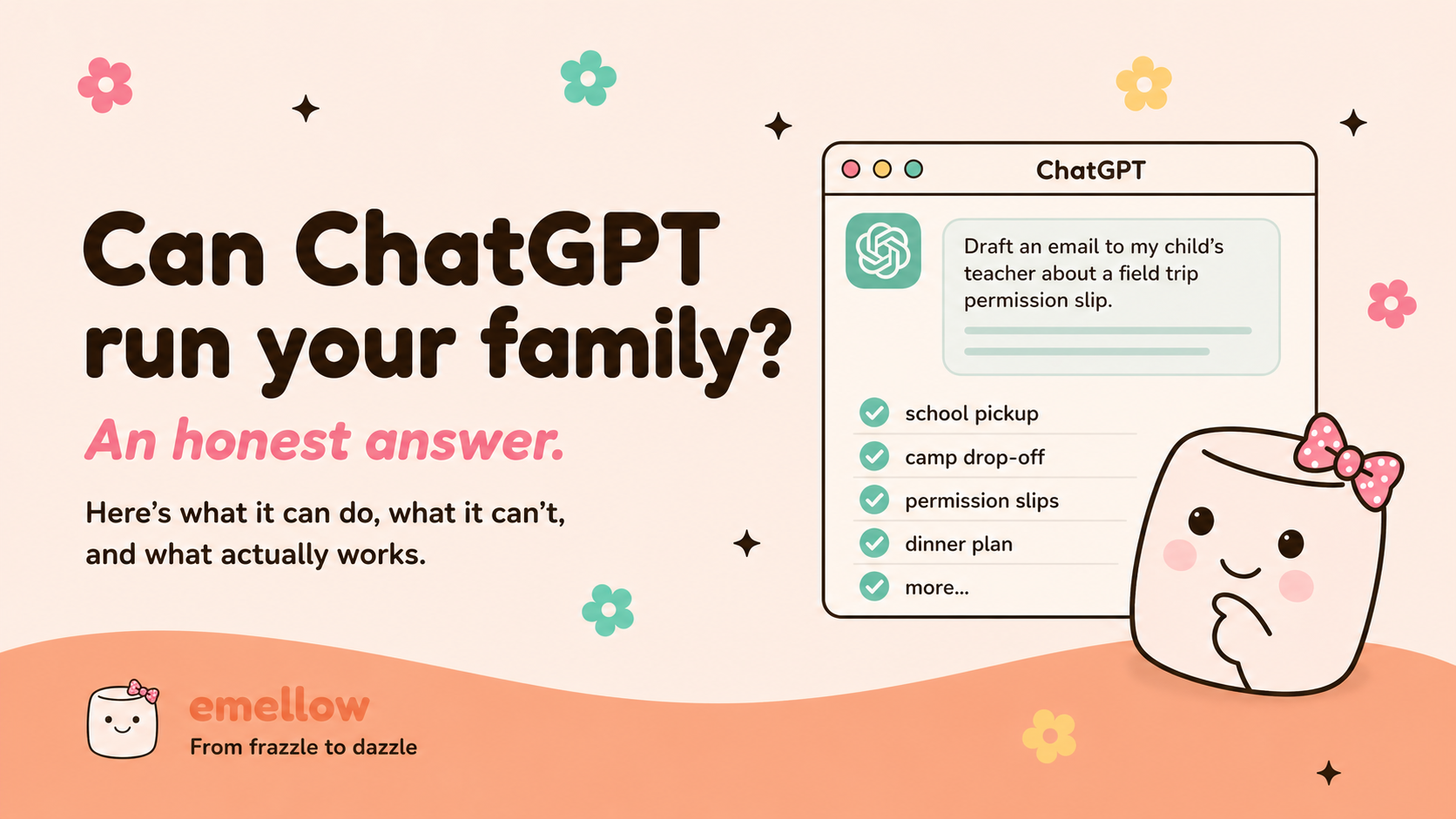
It's 7:14 a.m. You're at the kitchen counter, half a coffee in, scrolling the school portal for the field trip email from last Tuesday. The bus leaves at 8:40. You paste the email into ChatGPT — summarize this for me, tell me what my kid needs — and ChatGPT does a pretty good job. Permission slip. Packed lunch. White shirt, no logo. You tick through it. Good answer.
Then next week comes. Another field trip. Another email. You open ChatGPT fresh, because of course you do — it has no idea who your kid is, what camp your kid goes to in June, or that the white shirt from last week is in the laundry. Every week is week one.
That's the honest answer to can ChatGPT run your family. ChatGPT is very good at the reply. It was not built for the anticipating and monitoring that the family year actually runs on.
what ChatGPT is genuinely good at
Let's give credit where it's earned. ChatGPT will:
- Summarize a dense teacher email into three bullets in four seconds.
- Draft a thank-you note to the coach that sounds like a person wrote it.
- Turn a photo of a permission slip into a filled-out draft.
- Generate a packing list for a four-day Disneyland trip with two kids under seven.
- Write you a birthday-party invite that doesn't sound like a CVS card.
- Suggest dinner for Tuesday when the fridge has six ingredients and three opinions.
All real. All useful. All things the default parent in the house has been Googling for a decade. ChatGPT is a genuinely good co-writer and a genuinely good one-off assistant. If the whole problem you have is I need a 90-second reply written slightly faster, ChatGPT is a gift.
Most of parenting isn't that.
the jobs parenting actually runs on
The default parent in most households isn't mostly doing the replies. They're doing the three jobs that happen before the reply:
- Noticing. The camp signup email that landed on a Saturday. The "bring a white t-shirt on Monday" buried on page four of a Thursday newsletter. The dentist-reschedule reminder that only shows up if you log into the portal. Noticing is the job of catching a thing while it's small — before it becomes the 7:14 a.m. panic-scroll.
- Remembering. Across weeks. Across months. The Evite you RSVP'd yes to twelve days ago. The travel-team fee due at the end of the month. The swim-lesson session that ends Thursday and re-opens for fall registration the Monday after. Remembering is the job of holding the family's rhythm so the calendar doesn't have to be perfect for the week to work.
- Surfacing. The right thing, at the right moment, without being asked. Not "here's everything on your plate." Here's the camp signup that closes at 9:01 a.m., and it closes in eleven minutes. Surfacing is the job of bringing the noticing and the remembering forward at the exact moment you can actually use them.
That's the mental load. Not the replies. The three jobs underneath the replies. Allison Daminger's 2019 research names this as the invisible end of cognitive labor — the anticipating and the monitoring phases women disproportionately carry in households that look, from the outside, like everyone is pulling their weight.
ChatGPT does not do any of those three jobs. Not because it's a bad tool. Because it was not built for them.
why ChatGPT can't do the noticing
ChatGPT doesn't have your inbox. It doesn't know a new email arrived. It doesn't know your kid's school portal exists, let alone that a newsletter dropped Thursday at 4 p.m. with the permission slip due Monday. The noticing job requires persistent attention to incoming information. ChatGPT's attention starts when you open the tab and ends when you close it.
You can paste a specific email in and ask for a summary. That is not noticing. That is you doing the noticing, then handing the artifact to ChatGPT to compress it. The hard part — seeing the thing before you went looking for it — is still on you.
why ChatGPT can't do the remembering
Give ChatGPT credit: memory across sessions has been getting better. It will remember your kid's name, your preferences, your rough schedule — if you set it up, and if you stay in one thread, and if the context window holds.
The family year does not fit in a context window. Summer camp signup in February. VBS in May. Travel team tryouts in July. Back-to-school in August. Fall activity registration in September. Holiday gift lists in November. Teacher gifts in December. Tooth Fairy debt running the whole year. Each of those has its own small cast of details — sizes, allergies, forms, deadlines, what-to-brings — that don't belong in a prompt and don't belong in your head.
Finally, an answer to parent overwhelm shouldn't require you to prompt-engineer your own life every Sunday night.
why ChatGPT can't do the surfacing
Surfacing is the hardest of the three. It's not "answer when asked." It's "bring the right thing forward before asked." Surfacing is the difference between a kid who goes to the field trip with the white shirt — and a kid who watches a parent panic-scroll at 7:14 a.m. and show up with a logo t-shirt and an apology.
ChatGPT doesn't surface. ChatGPT answers. If you don't ask, it sits there. The noticing you didn't do, the thing you didn't remember to ask about — ChatGPT cannot rescue either of those, because it doesn't know they happened.
the test we use
When we evaluate any tool in the "AI for parents" category, we run it against three questions, in order:
- Does it notice the thing when it arrives?
- Does it hold the thing across weeks?
- Does it bring the thing back at the right moment?
ChatGPT is a yes on zero, with a generous asterisk on number two. That's not a knock. That's a category mismatch. ChatGPT was built to be a brilliant generalist at language — and it is — not a persistent attention layer on your family's year. Expecting it to run your family is like expecting a photocopier to run your mail route. Both useful tools. Different jobs.
what you actually need (and what we built)
mellie is an AI personal assistant for parents. Not a productivity app with a parent skin. Not a family calendar with a chat bubble bolted on. A persistent attention layer — an assistant that reads the school emails, the camp signups, the group texts, the travel-team thread — and does the three jobs ChatGPT can't: the noticing, the remembering, the surfacing.
Built by parents, for parents. We built mellie because we were the parents in the kitchen at 7:14 a.m. pasting emails into ChatGPT and hoping. ChatGPT is a great tool. It was not the tool.
memorable parenthood is the outcome. Showing up on time, everything in hand, all forms signed, white shirt clean — because the noticing and the remembering and the surfacing were handled while you were doing the part that was always the point: being in the room with your kid.
the honest bottom line
Keep ChatGPT. It's a great co-writer. Use it for the reply, the thank-you, the packing list, the dinner-from-the-fridge. That's where it earns its keep.
For the year your family is actually running — the camp window that closes at 9:01, the field trip detail buried on page four, the Evite that's been sitting eight days — you don't need a faster reply. You need something that noticed in the first place.
Happy, healthy, mellow. That's the bar. try mellie for free today.