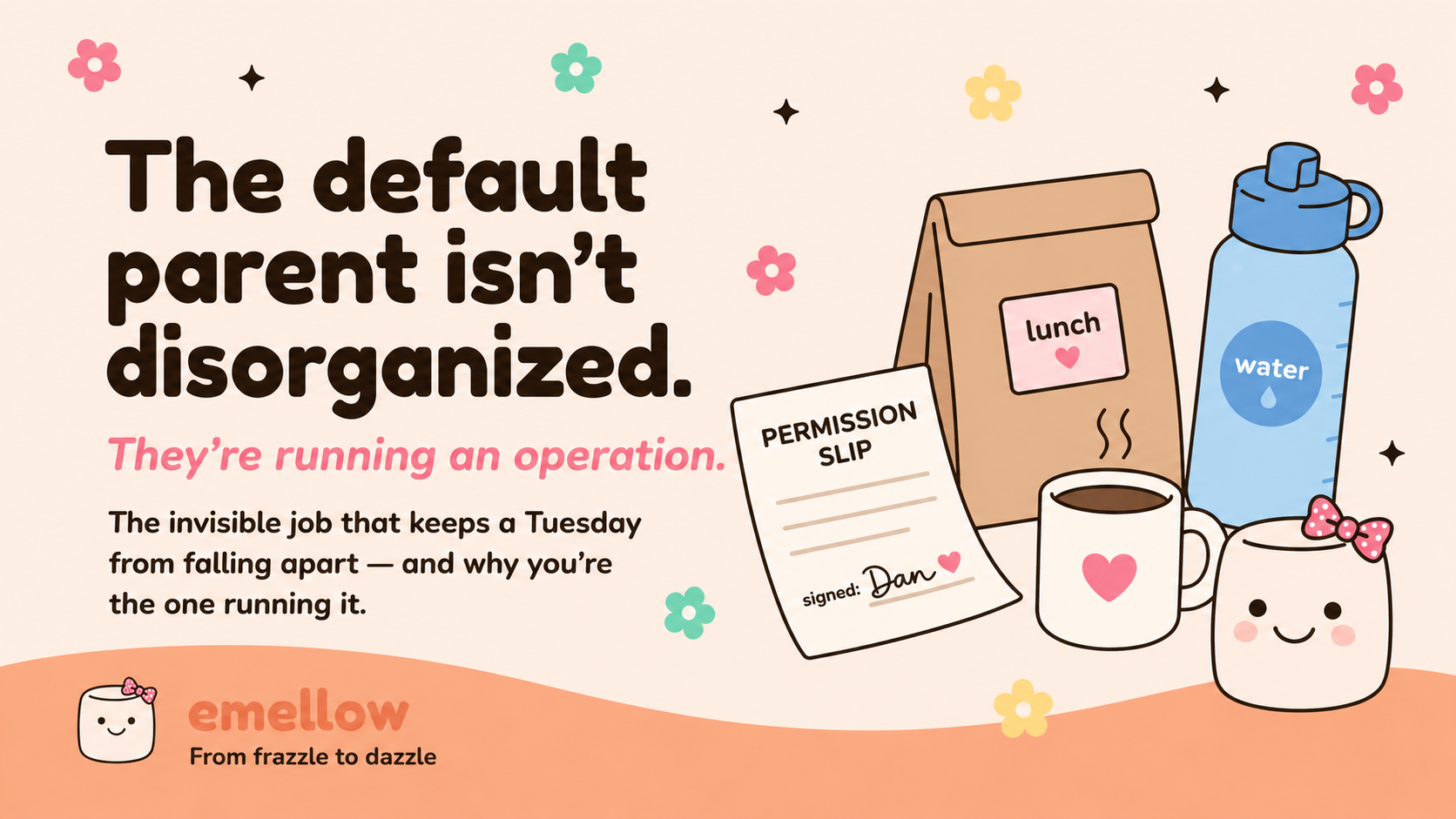
It's 7:12am on a Tuesday. The field trip is today. You know this because you've known it for eleven days — the permission slip went in her folder on the tenth, the five dollars went in on the twelfth, and the sack lunch in a disposable bag (not the usual lunchbox, the teacher was specific) is already on the counter. Your kid is eating waffles. She looks up and asks if you remembered her water bottle. You had. It's in the backpack. She goes back to the waffles. You stand at the sink and feel, for one small second, like maybe you are losing your mind — because everything is handled and you still can't sit down.
That's not disorganization. That's the tail end of an eleven-day operation only one person was running.
you are not scattered. you are the operations department.
the story we've been told
The story goes like this: some parents are just more organized than others. They have systems. Spreadsheets. A tidy little planner. You — apparently — do not, because you forgot the soccer snack again, or you almost missed the camp signup, or you looked blank at pickup when the teacher asked if you'd seen her note about the reading log.
The story is wrong. Not wrong in a soft, self-help way. Wrong in a logistics way.
The mental load isn't a personality trait. It's an operational volume problem. And when the volume exceeds what any one person can hold, the thing that fails first isn't the operation — it's the operator's sense that they're competent.
what a logistics problem actually looks like
A project manager at work gets a shared drive, a status meeting, a Slack channel, and a team of people who each own pieces of the thing. A default parent gets: their head.
They track, in their head:
- The camp that opens registration on January 15 at 9am and closed last year at 9:01.
- The VBS what-to-bring list that arrived six weeks out in an email titled "important!" with no dates in the subject line.
- Which kid grew out of which swimsuit and by how much.
- The pediatrician who said come back in six months, which was four months ago.
- The birthday party three Saturdays from now that hasn't been RSVP'd to because they still haven't decided if their kid even likes that kid anymore.
- The form the coach handed them at the field, folded twice, that's now somewhere in the passenger seat.
- The Tooth Fairy schedule.
No shared drive. No Slack channel. No team. Just them, and a brain that is also supposed to be reading Goodnight Moon at bedtime without wandering off mid-sentence.
The research backs this up in the cleanest way: the Archives of Women's Mental Health (Dean et al., 2023, out of the Saxbe Lab at USC) found that partnered mothers spend more than twice as much time as fathers on what the researchers call cognitive labor — and that the cognitive piece predicts mental-health strain harder than the physical household work does. A 2024 Bath study put the share at seventy-one percent of household cognitive labor falling to one parent. These aren't vibes. They're numbers.
The numbers, translated: it isn't them. It's the load.
finally, an answer to parent overwhelm
Here is what changes the picture. The invisible parts of the operation — the noticing, the holding, the remembering — don't have to keep living rent-free in one person's head.
mellie reads the school email, the camp signup, the coach's group text, the VBS what-to-bring list. She pulls the thing that matters out of the noise and hands it to you when you actually need it. Not a dashboard of fourteen more things to check. The permission slip, on Wednesday night, before bed. The camp window, at 8:55am, five minutes before it opens. The field-trip water bottle, in the morning, while you're still in pajamas.
That's the promise. Not "more productive." Not "better organized." Memorable parenthood — showing up on time, everything in hand, all forms signed. Making memories instead of searching for the soccer snack calendar.
No more panic-scrolling. Ever.
the two invisible ends (the part this topic keeps coming back to)
Sociologist Allison Daminger's 2019 research names the cognitive work of running a household in four phases: anticipating and monitoring sit on either end, with identifying and deciding in the middle. Anticipating is seeing the thing coming before anyone else does. Monitoring is watching to make sure the thing you set in motion actually lands.
Those two phases — the invisible ends — are where the load concentrates. Daminger's data, and the studies that have stacked on top of it since, show the same pattern: when the work gets divided, the visible middle (the decision, the execution) is what gets shared. The anticipating and the monitoring stay with one parent. That parent is usually the one who was doing them already.
We'll walk through the four phases in plain language in anticipating and monitoring: the two parts of parenting nobody sees you doing. For now, the short version: the reason you can't turn off at 8pm isn't because you didn't do anything. It's because the two phases you were doing all day don't have an off switch.
what "running an operation" actually looks like on a normal week
Pick any random Wednesday. Walk through it from an operations lens instead of a personality lens.
The kid wakes up. You've already been scanning — mentally, before your feet hit the floor — for what today is. Library day? Show-and-tell? The week the lunches pivot because of the field-trip schedule? You noticed the shoes were getting tight on Sunday and you've been monitoring whether they're still okay, or whether today is the day you call it and order the next size. You remembered that the dentist left a voicemail. You haven't called back. You remember this every twenty minutes.
By 8am you've executed one or two visible tasks (packed the lunch, signed the form) and run twenty-plus invisible ones. The visible ones leave evidence. A signed form. A made lunch. The invisible twenty leave nothing — except the ongoing hum in your chest that something somewhere is still unhandled.
This is not a character flaw. This is the job.
what changes when the operation has infrastructure
Think about any other role that holds this kind of volume. A stage manager has a prompt book. A line cook has tickets. A project manager has a board. None of those people are expected to hold every cue, every order, every milestone in their head — and if you asked them to, the whole thing would go sideways by lunchtime.
The default parent has been running their operation without a prompt book. That's the honest picture.
When mellie sits in the email and the group text and the signup portals, the operation finally gets infrastructure. The noticing happens in a place that isn't your head. The remembering happens in a place that isn't your head. The surfacing — the "here's the thing you need, now" moment — happens when you actually need it, instead of at 10:47pm when your brain is trying to fall asleep.
You still run the operation. You're just no longer also the filing system.
built by parents, for parents
We built mellie because we were running the same operation you are, and we were tired of the story that said we were the problem. We aren't. You aren't. Built by two parents who were drowning — which is to say, we know exactly which Tuesday this post is about, because we've had it.
The kid at the breakfast table. The eleven-day operation that ended in a sack lunch on the counter. The standing-at-the-sink feeling that something's still unfinished. All of it.
You are not disorganized. You are running an operation that was never designed to be run by one person with no tools and no team. The goal isn't to make you more efficient at carrying the load. The goal is to get some of the load out of your head, so the part of parenting you actually wanted to be doing — the Goodnight Moon part, the waffles-and-a-question part — is the part you can actually be doing.
Happy, healthy, mellow.
Keep reading. Next up in this topic: anticipating and monitoring: the two parts of parenting nobody sees you doing. And for the 8pm-math version of this: why you're tired at 8pm on a day you "didn't do anything".
Want mellie to carry some of this for you? try mellie for free today — she'll run the operation alongside you.