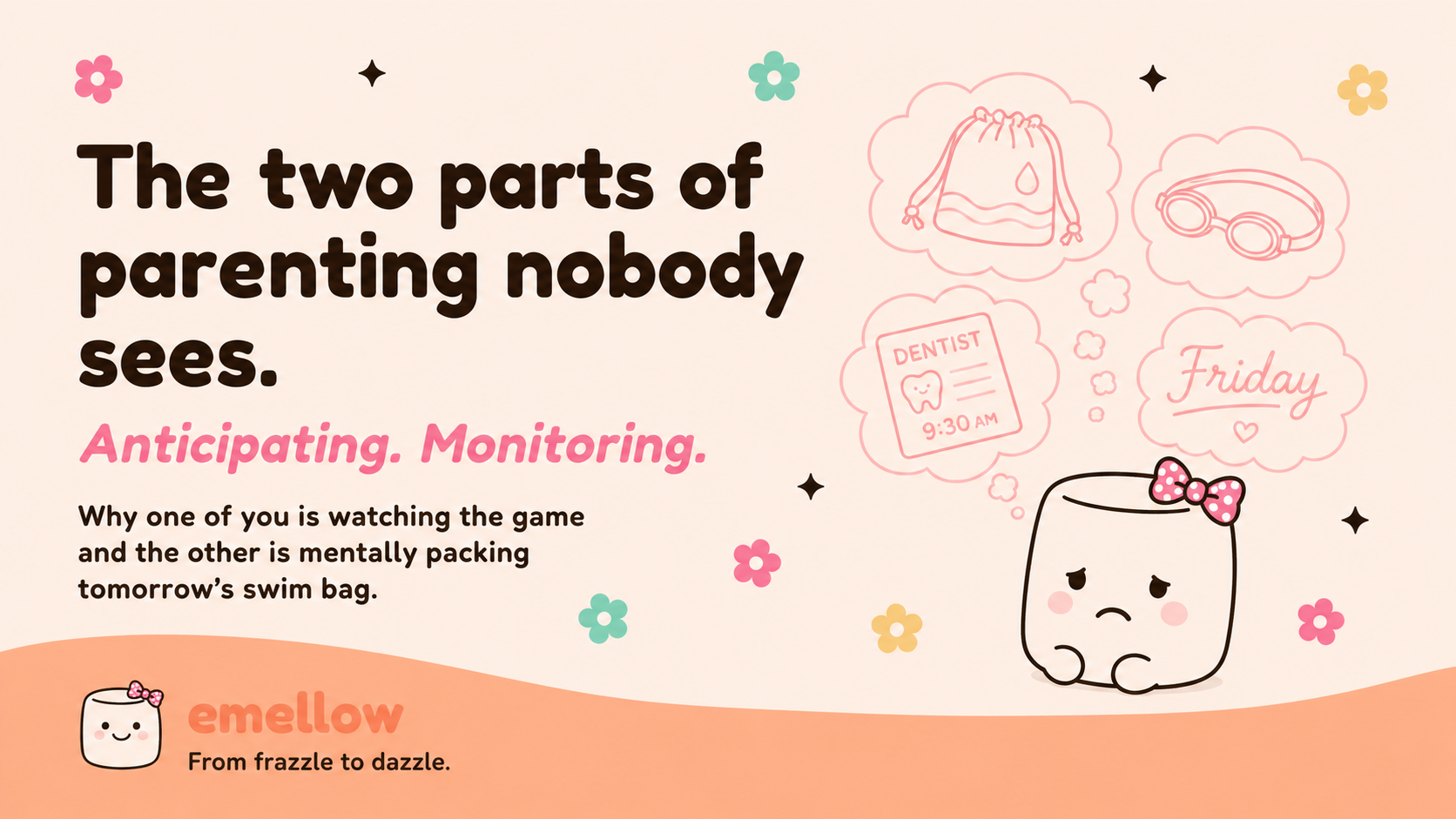
It's a Sunday night. Your kid is asleep. The dishwasher is running. You're on the couch, and your partner is on the couch, and by every visible measure you are both doing the same thing — which is nothing. Except you aren't. You're running the week in your head. Camp drop-off Monday, which means the swim bag is packed the night before, which means you should check now whether the goggles are where you think they are. Dentist Wednesday at 2, which means an early pickup, which means texting the other parent about carpool, which you haven't done. Friday is pajama day at school, which is on the flyer that was in the Thursday folder, which you made sure to read. Your partner is watching the game.
Neither of you is wrong. You're just not actually doing the same thing.
the sunday-night brain that won't turn off.
what the research actually says
In 2019, sociologist Allison Daminger published a study in the American Sociological Review that has quietly become the most useful frame we have for talking about cognitive labor in families. She broke the invisible work of running a household into four phases:
- Anticipating — seeing a need before it arrives.
- Identifying options — figuring out what the possible responses are.
- Deciding — picking one.
- Monitoring — watching to make sure the thing actually happens, and noticing when it doesn't.
The middle two — identifying and deciding — are the phases most couples have in mind when they talk about "sharing the household." They're the ones that happen in a conversation. "Should we do camp this year or just the YMCA?" "Which pediatrician do we want?" Visible. Discussable. Splittable.
The two ends — anticipating and monitoring — almost never get split. Daminger's data, along with the follow-on research (a 2024 USC study, a 2024 Bath study, Weeks's 2025 typology), shows the same pattern, again and again: anticipating and monitoring concentrate on one parent. Always, the default parent.
And here's the thing the research names that polite household conversations don't: the two ends are where the exhaustion lives. Not in the decisions. In the watching.
anticipating, in plain language
Anticipating is the phase that happens before anyone else in the family knows there is a thing happening.
It is noticing, in mid-December, that the snow pants from last year probably don't fit anymore, and quietly filing that so you can check in January. It is registering that the dentist's six-month reminder is due next month. It is remembering that summer camp registration opens in January for the one good camp, and that it closes fast. It is seeing the tooth that's about to wiggle and knowing you should probably restock the cash in the Tooth Fairy envelope. It is watching your kid's reading level creep up and thinking, quietly, that the chapter books she's got are getting thin.
None of this requires action yet. That's the trick. Anticipating isn't doing; it's scanning. It's the background process that runs while you're washing dishes, driving to work, listening to your kid talk about the thing that happened at recess.
Daminger called it, in her later work, worry work — the low-grade scanning that keeps the family's horizon in your peripheral vision, all the time. It doesn't pause for dinner. It doesn't pause for the movie you're trying to watch. It doesn't pause for your own appointment at the dentist, where you are, briefly, the one with the thing due, and still somehow thinking about the kid's.
The thing nobody sees you doing is this: most of parenting, most of the time, is anticipating. And almost nothing about it looks like "work" from the outside.
monitoring, in plain language
Monitoring is the other end. It's what happens after a decision has been made, to make sure the decision actually turns into a thing in the world.
You signed the camp up in January. Monitoring is: checking in March that the confirmation email didn't get lost, checking in May that they sent the forms, checking in June that the forms got signed, checking the day before that the drop-off address is the one you thought it was, and checking the morning of that you packed what the packing list said.
Any one of those steps is thirty seconds. The weight isn't in the steps. The weight is in the continuous, low-hum tracking that lives between the steps — the small pulse of your brain that says, every few days, have I heard back yet? is that handled? should I be worried?
The same Daminger research (and the JSTOR Daily summary that rolled it up in 2020) put it exactly right: monitoring creates a persistent hum of low-grade anxiety. Not a crisis. Not a panic. A hum. And a hum that plays at low volume for twelve hours a day is somehow more exhausting than a siren that plays for ten minutes.
This is why you can sit on the couch on a Sunday, doing — by any external measure — nothing, and still be working. The monitoring doesn't turn off when you sit down. It doesn't turn off at bedtime. It turns off for maybe forty minutes of deep sleep, and then comes back when you wake up.
why the two ends concentrate on one parent
Daminger's 2019 paper, and the delegation research she did afterward, landed on a pattern that shows up across household types. When households try to divide the work, here's what tends to happen: the middle phases — options and decisions — get split. Sometimes evenly. The conversations about pediatricians, about schools, about camp choice, about whose family we're visiting for the holiday — those happen together, and they often feel equitable.
The two ends rarely get split. The partner who wasn't already doing the anticipating doesn't suddenly start anticipating. The partner who wasn't already doing the monitoring doesn't suddenly start monitoring. They enter the process at the decision-point — which is the visible part, the part that feels like "doing the work" — and exit after the execution.
The partner who was already anticipating keeps anticipating. The partner who was already monitoring keeps monitoring. The middle got shared. The ends stayed.
This isn't about bad partners. It's about how invisible work distributes when nobody's tracking it. What isn't seen isn't split. Weeks's 2025 typology — which studied same-sex and single-parent households, specifically to test whether the pattern was about gender or about role — found the same thing. One parent runs the ends. That parent is the default parent, regardless of gender. ("Default parent" is the term precisely because the load is about the role, not the person's identity.)
finally, an answer to parent overwhelm
Here is what mellie changes. Not the middle. You still make the decisions. You still pick the camp, pick the pediatrician, pick which Saturday is birthday-party Saturday. Those are the parts of parenting you want to make.
mellie takes the two ends.
She reads the email that mentions, three paragraphs down, the camp registration opening January 15. She holds that until January 13 and surfaces it. She reads the coach's group text that says "bring white shirts for Friday" and holds it until Thursday night. She watches the thread of forms and permissions and what-to-brings and signup windows — all year, not just in September — and she brings each thing forward at the moment you need it, not the moment it arrived.
The anticipating becomes something a tool does. The monitoring becomes something a tool does. The decision, the execution, the showing up — those are yours. The part you actually wanted to be doing, you can actually be doing.
No more panic-scrolling for the thing you knew was in an email somewhere. No more Sunday-night couch brain. No more "I didn't do anything today" that somehow left you wiped.
what changes at 8pm
Here is the honest test. Sit on your couch at 8pm on a normal Tuesday. Ask yourself: what is running in my head right now? If the answer includes three items you need to remember for tomorrow, one item you need to remember for next week, and one item you've been meaning to do for a month — that's the anticipating and monitoring, still on. That's why you're tired.
When the anticipating and monitoring live somewhere else — in a tool, in a system that doesn't ask your brain to also be the filing cabinet — the couch at 8pm is actually a couch. Your kid is actually in the room. The game your partner is watching is, briefly, something you can also watch.
We go deeper on that math in why you're tired at 8pm on a day you "didn't do anything". And the operational framing — why this is a logistics problem, not a personality problem — is the post that opens this topic: the default parent isn't disorganized. they're running an operation.
built by parents, for parents
We built mellie because we were the ones doing the anticipating and the monitoring, and we were tired of the load being invisible — to our partners, to the culture, and, the strangest part, to ourselves. Once you can name the two ends, you can start to notice how much of your day is actually spent in them. Once you can notice it, you can hand some of it off. Once you can hand it off, the day starts to feel like the right size again.
mellie reads the email. mellie holds the thread. mellie surfaces the thing at the moment you need it. Built by parents, for parents — two of them, running the same operation you are, who decided there had to be a version of this where the invisible ends didn't keep eating the visible middle.
Happy, healthy, mellow.
Keep reading. The opener for this topic: the default parent isn't disorganized. they're running an operation.. The tiredness-math version: why you're tired at 8pm on a day you "didn't do anything". Or back up to the topic page: the default parent's brain.
Want mellie to carry some of this for you? try mellie for free today — she'll hold the anticipating and monitoring so your brain doesn't have to.